
%20(1).jpg)
Unearthing Nature and Brutalism will be presented at Miminat Designs’ London atelier in St John’sWood from 2 December 2025 to 28 February 2026, in collaboration with Atlas Gallery. Theexhibition brings together photographic works and Miminat Designs’ sculptural furniture to explorethe dialogue between nature, art, and brutalist architecture. Highlights include powerfullandscapes by Sebastião Salgado, meditative Seascapes by Hiroshi Sugimoto, and abstract aerialworks by Kacper Kowalski. At its centre is the Howard Daybed, reimagined in a special editionhonouring founder Miminat Shodeinde’s Yoruba heritage. The exhibition is viewable by appointmentonly..

Sebastiao Salgado
Sebastião Salgado studied economics and began his career as a professional photographer in 1973 in Paris. He is one of the most celebrated photographers in the world today. After working with the photo agencies Sygma, Gamma, and Magnum Photos until 1994, he and his wife, Lélia Wanick Salgado, founded Amazonas Images.He has travelled and photographed in over 120 countries worldwide.
His work is presented in numerous books, including Other Americas (1986), Sahel: l’homme en détresse (1986), Sahel: el fin del camino (1988), Workers (1993), Terra (1997), Migrations and Portraits (2000), Africa (2007), and Genesis — an epic project lasting from 2004 to 2011 that documents the world’s unspoiled wildernesses.
Touring exhibitions of his work have been, and continue to be, presented around the world. Salgado has been awarded numerous major photographic prizes in recognition of his accomplishments, and his work is held in major museum collections worldwide.
A V A I L A B L E W O R K S
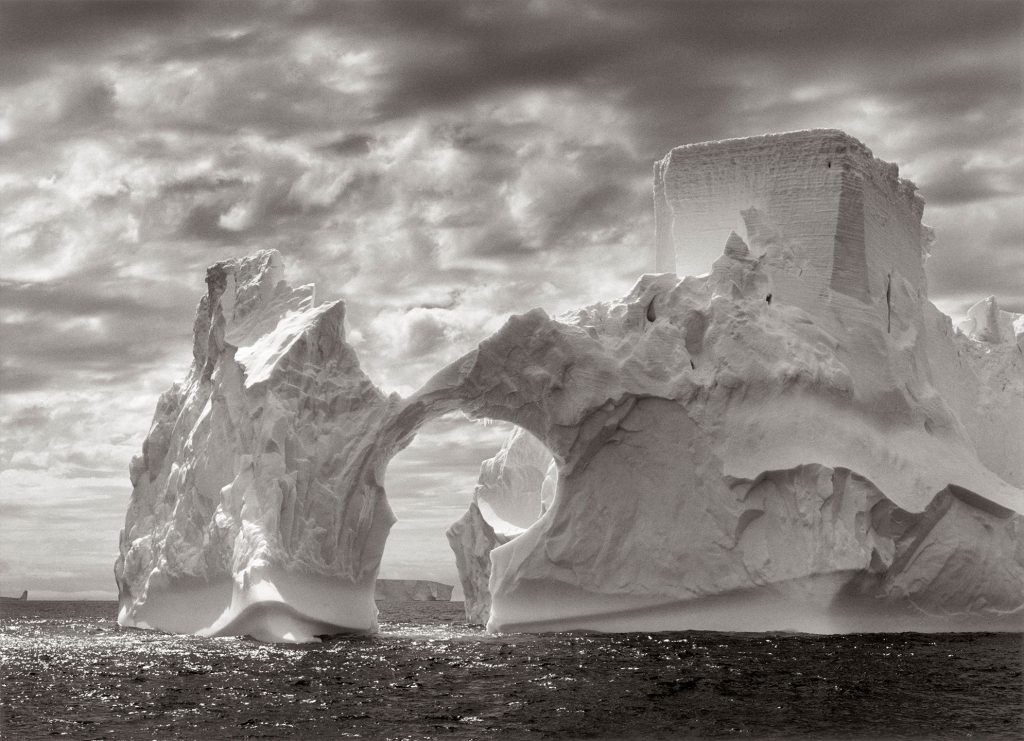
Sebas:ao Salgado
AntarcEca, Iceberg, "The Castle", 2009 Life-Time print made underSupervision of SebasRao Salgado, authorised and signed by LeliaWanick Salgado
GelaRn silver print
122 x 168 cm, framed behind glass to 126 x 172cm
(SES001)
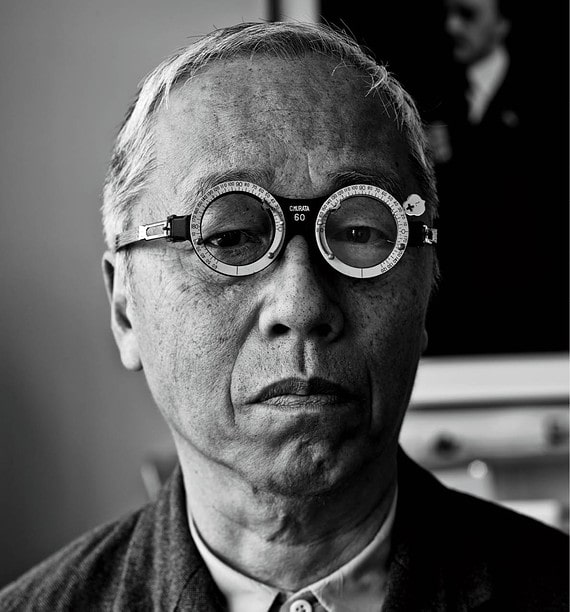
Hiroshi Sugimoto
Hiroshi Sugimoto (b. 1948) is a contemporary Japanese photographer whose esoteric practice explores memory and time. Using the intrinsic quality of long-exposure photography, the artist provides insight into how the medium can both obscure and alter reality.
Influenced by Dadaist and Surrealist theory, Sugimoto’s Seascapes, Dioramas, and Theaters craft mysterious scenes from vernacular subject matter.“Photography is like a found object. A photographer never makes an actual subject; they just steal the image from the world,” the artist said. “Photography is a system of saving memories. It’s a time machine, in a way, to preserve the memory, to preserve time.”In the mid-1970s, Sugimoto moved to New York.
He was the recipient of the Hasselblad Award in 2001 and the subject of a mid-career retrospective in 2006, organized by the Hirshhorn Museum and Sculpture Garden in Washington, D.C., and the Mori Art Museum in Tokyo.The artist currently lives and works between New York, NY, and Tokyo, Japan.
Sugimoto’s works are presently held in the collections of the Art Institute of Chicago, The Museum of Modern Art in New York, the National Gallery of Art in Washington, D.C., and the Centre for Contemporary Art in Kitakyushu, Japan.
A V A I L A B L E W O R K S

Hiroshi Sugimoto
Sea of Japan, Oki, #307, 1987 Blind-stamped Rtle, date, and numberon mount, recto
Tri-toned offset lithograph, mounted on card
Printed in the Mitsumura PrinRng Co., Ltd., Tokyo
24.1 x 31.1 cm (9 1⁄2 x 12 1⁄2 in.) - mount 35 x 46.4 cm (13 3⁄4 x 181⁄4 in.)
EdiRon of 500
(HS001-2)

Hiroshi Sugimoto
Ionian Sea, Santa Cesara, #344, 1990 Blind-stamped Rtle, date, and number on mount, recto
Tri-toned offset lithograph, mounted on card
Printed in the Mitsumura PrinRng Co., Ltd., Tokyo
24.1 x 31.1 cm (9 1⁄2 x 12 1⁄2 in.) - mount 35 x 46.4 cm (13 3⁄4 x 181⁄4 in.
)EdiRon of 500
(HS013-2)

Hiroshi Sugimoto
Aegean Sea, Pilion, #350, 1990 Blind-stamped Rtle, date, and number on mount, recto
Tri-toned offset lithograph, mounted on card
Printed in the Mitsumura PrinRng Co., Ltd., Tokyo
24.1 x 31.1 cm (9 1⁄2 x 12 1⁄2 in.) - mount 35 x 46.4 cm (13 3⁄4 x 181⁄4 in.)
EdiRon of 500
(HS041-2)
Hiroshi Sugimoto
Norwegian Sea, Vesteralen Island, #335, 1990
Blind-stamped Rtle, date, and number on mount, rectoTri-toned offset lithograph, mounted on card
Printed in the Mitsumura PrinRng Co., Ltd., Tokyo
24.1 x 31.1 cm (9 1⁄2 x 12 1⁄2 in.) - mount 35 x 46.4 cm (13 3⁄4 x 181⁄4 in.)
EdiRon of 500
(HS016-2)
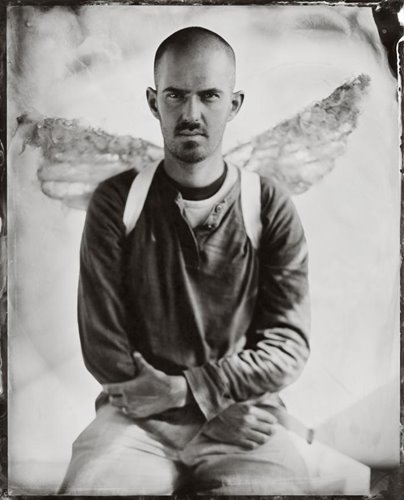
Kacper Kowalski
Polish photographer Kacper Kowalski (b. 1977) lives and works in Gdynia. His unique photographs are aerial pictures of natural and urban environments across Poland.
After studying architecture, he devoted himself entirely to flying and photography—two of his passions. As a paraglider, a pilot of small aircraft, and a gyrocopter, Kowalski would fly into the air with an engine strapped to his back to discover the world of form, shape, and pattern. From 150 meters above the ground level, the landscape he chose to see and capture on camera became abstracted.
He has received numerous awards, including the Sony World Photography Award for Best Landscape Photography (2023) and the World Press Photo Award (2009, 2014, 2015), the Picture of the Year International (POYi) Award (2012, 2014, 2015, 2016), and many others. His first photography book, Side Effects, was published in early 2014, and his second photo-book, OVER, in September 2017; Arché in 2021; and Event Horizon in 2022. Rising in the frosty, cold air, Kowalski feels suspended in time and space.
He describes reaching a new point of view that resulted in poetic and personal photographs, where a state of mind is communicated beyond patterns, shapes, and colours. His work feels very meditative and channels liberating themes such as perspective and interpretation.

Kacper Kowalski
Arché #24, 2018 Signed, Rtled and dated Archival pigment print 120x 90 cm
(KK002)
-min.jpg)
Verena Bachl
Verena Bachl (*1985, Wörth a.d. Donau, DE) follows a post-minimalist approach in her sculptures and installations, characterized by a strong conceptual foundation.
By employing charged materials—metaphorically and physically—such as marble, silicon, fluorescent tubes and magnets, she stages matter and its interactions as works of art. Some of her works incorporate industrial objects as architectural structures through which she explores the potential of material memory and processes of storage by means of energy and information.
The presence of her chosen materials often evokes both mystical and digital associations, allowing physical phenomena to transform into sculptural form.Her practice unfolds through a dynamic collision of material autonomy, ephemeral abstraction, and the elemental forces of physics.
Light and energy permeate her installations, immersing her sculptures in synthetic atmospheres that oscillate between the archaic and the futuristic.By staging functional objects as relics—stripped of their original purpose and reimagined as ambiguous artefacts—Bachl creates speculative scenographies. These juxtapositions of minimalist form, technological implementation, and contrasting textures of metal, glass, and stone open a poetic space of uncertainty, resistance, and the irreducible presence of the unknown.
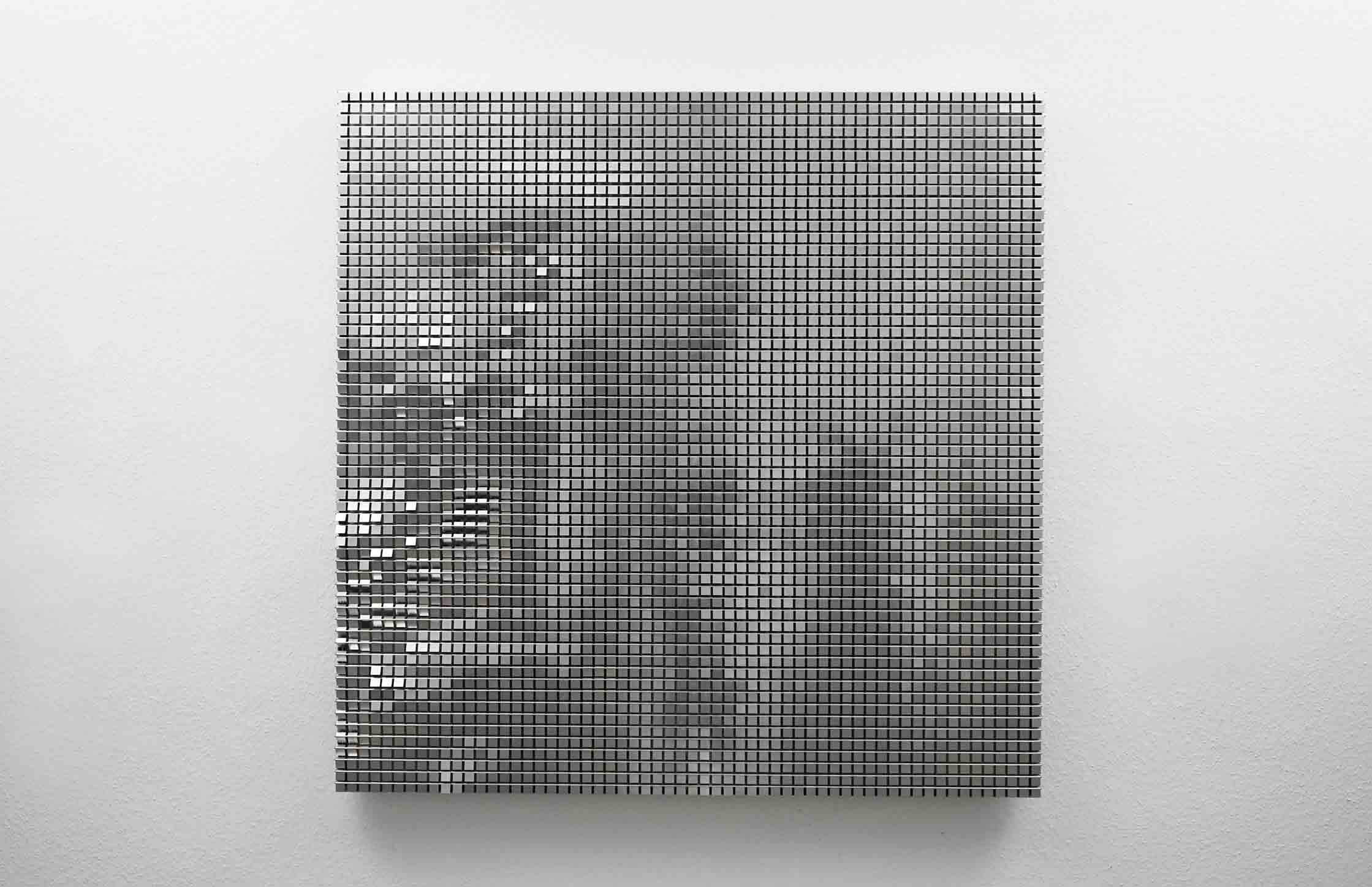
Wave Fragment
2019
150 X 150 X 12 cm
59 X 59 X 4.7 inches
Aluminum, steel, stainless steel, brass (platinum-plated), fans, electronics
(KK002)